01
Data intake
LOGFAS remains the source. Relay resolves units down to the individual object, with dimensions, weight and load class, and pairs cargo with carrier before departure day forces it.
Relay · Logistics
Relay runs the deployment nodes of Germany's logistics hub: seaport, airport, railhead and convoy support centre. What comes out of NATO planning becomes a site plan, is executed in the field and reported back as evidence.
What Relay does
Relay is the software for the place where units are transloaded: from ship to road, from road to rail, from aircraft into the convoy.
01 · Situation
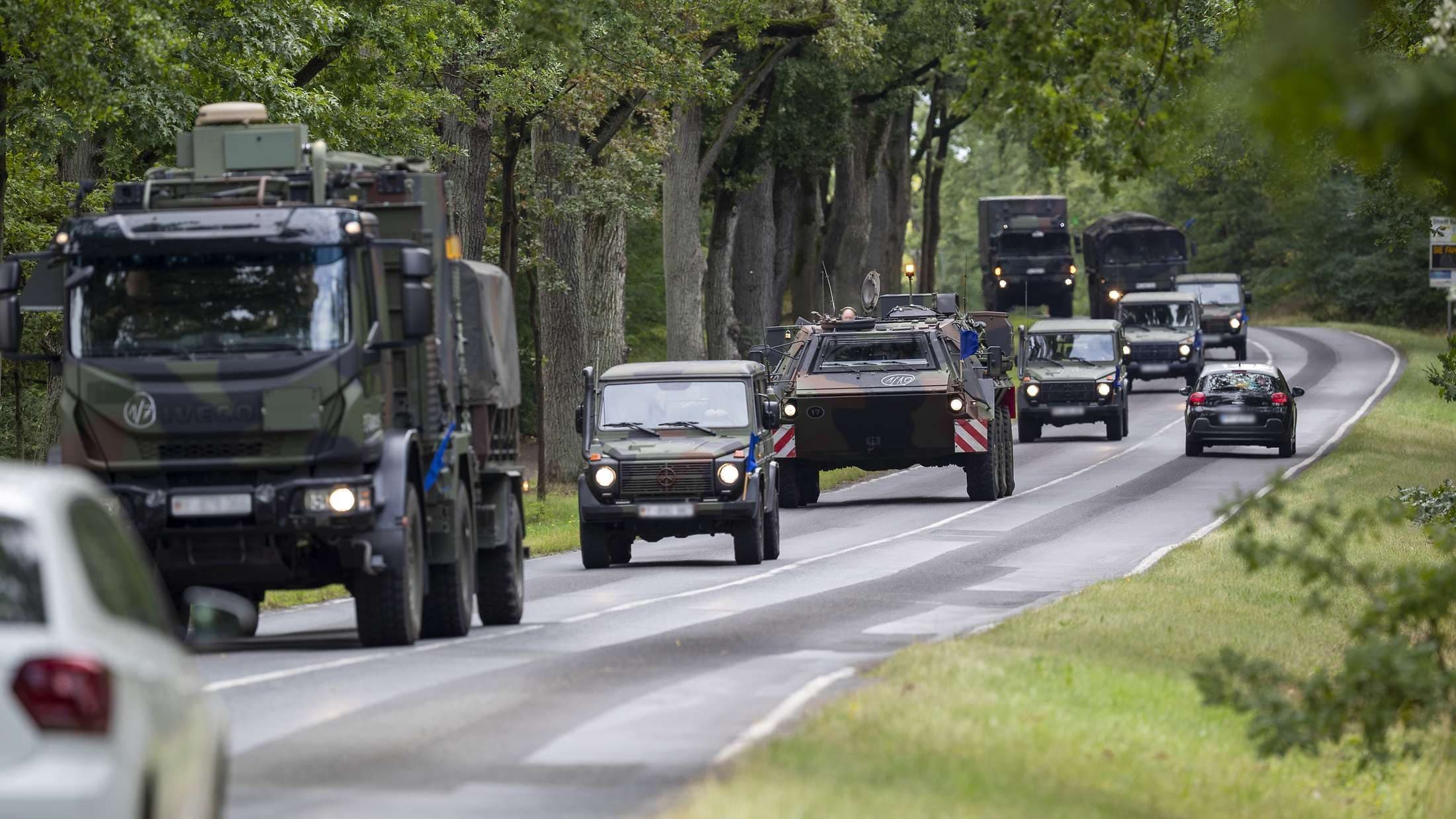
Allied units arrive at German seaports, airports and railheads and must move on east. At each of these nodes hundreds of vehicles and containers are unloaded, parked and sent off again in convoys.
02 · Problem
NATO planning says which unit arrives when. What then fits on which area, in which order it is parked and who blocks whom is handled today with experience, spreadsheets and radio. That costs hours per convoy, and nobody knows exactly what is on the ground right now.
03 · Solution
Relay takes the NATO plan, calculates what fits on the area, assigns every vehicle a slot and guides the staff in the field by handheld. What happens is logged and reported back to planning. Offline, even without an outside connection.
Four modules
Sending nation, host nation and command structure work on the same picture. The NATO plan becomes a site plan, the site plan becomes work in the field, the work in the field becomes evidence.
01
LOGFAS remains the source. Relay resolves units down to the individual object, with dimensions, weight and load class, and pairs cargo with carrier before departure day forces it.
02
Draw the node area on the map, calculate capacity instead of guessing, derive the parking order from the departure sequence. Whoever drives in first no longer ends up at the back.
03
The same picture, reduced for the marshal to the next action: slot, carrier, conflict warning. Capture at the object via QR or RFID, offline on the local network, less radio traffic.
04
Complete event log, throughput, dwell time, commander's report. Actual data back into planning. The follow-on operation stands on real numbers.
Nodes
Space. Heavy equipment in loading order, separated from the carrier. The node type Yarded was field-tested on.
Apron. The clearing sequence controls the arrival rate, cadence in minutes.
Ramp and train formation. A sequencing error shows up hundreds of kilometres later.
Supply as the binding resource: fuel, food, repair. Without the CSC, the unit does not get through.
Origin
„After two hours of training, as fast as after two years in the old process.“
Field trial with Logistics Battalion 163, January 2024
June 2022
The Bundeswehr Logistics Command and the Cyber Innovation Hub select eight prototypes from 86 ideas. Yarded is one of them.
2023
Process mapping during a real mission at the port of Emden, workshops with the troops, demonstrator delivered in September.
November 2023
Military Mobility category, Ljubljana. Ahead of 39 ideas, including major international consultancies.
January 2024
Three days under real conditions with soldiers of Logistics Battalion 163. Adjustments were deployed during the exercise.
2026
The team behind Yarded builds Relay at MKS as a new development: the seaport first, then airport, railhead and convoy support centre. Designed for disconnected operation and accreditation from day one.
Differentiation
Deployment nodes are not freight yards. Relay is built for the doctrine, the roles and the security situation of the troops.
01
Four node types, each with its binding constraint, march order, blocking logic and the pairing of carrier and cargo. No yard, terminal or ERP software has that.
02
NATO planning remains the source. Import as a file first, later via the interfaces of the new NATO logistics systems. No bolt-on, no replacement.
03
Dimensions, load classes, manoeuvring clearances, timeline. Relay calculates, proposes and explains. The authorised user decides.
04
Handheld flows for arrival, parking and retrieval. Offline on the local network, radio-light, with unique identifiers on the object. Derived from the Yarded field trial.
05
Complete event log, throughput, commander's report. Actual data back into planning and to headquarters.
06
Developed in Germany, designed for disconnected operation and accreditation. Need-to-know instead of everyone sees everything.
Boundary
Relay
Relay runs the deployment nodes of Germany's logistics hub: seaport, airport, railhead and convoy support centre. What comes out of NATO planning becomes a site plan, is executed in the field and reported back as evidence.