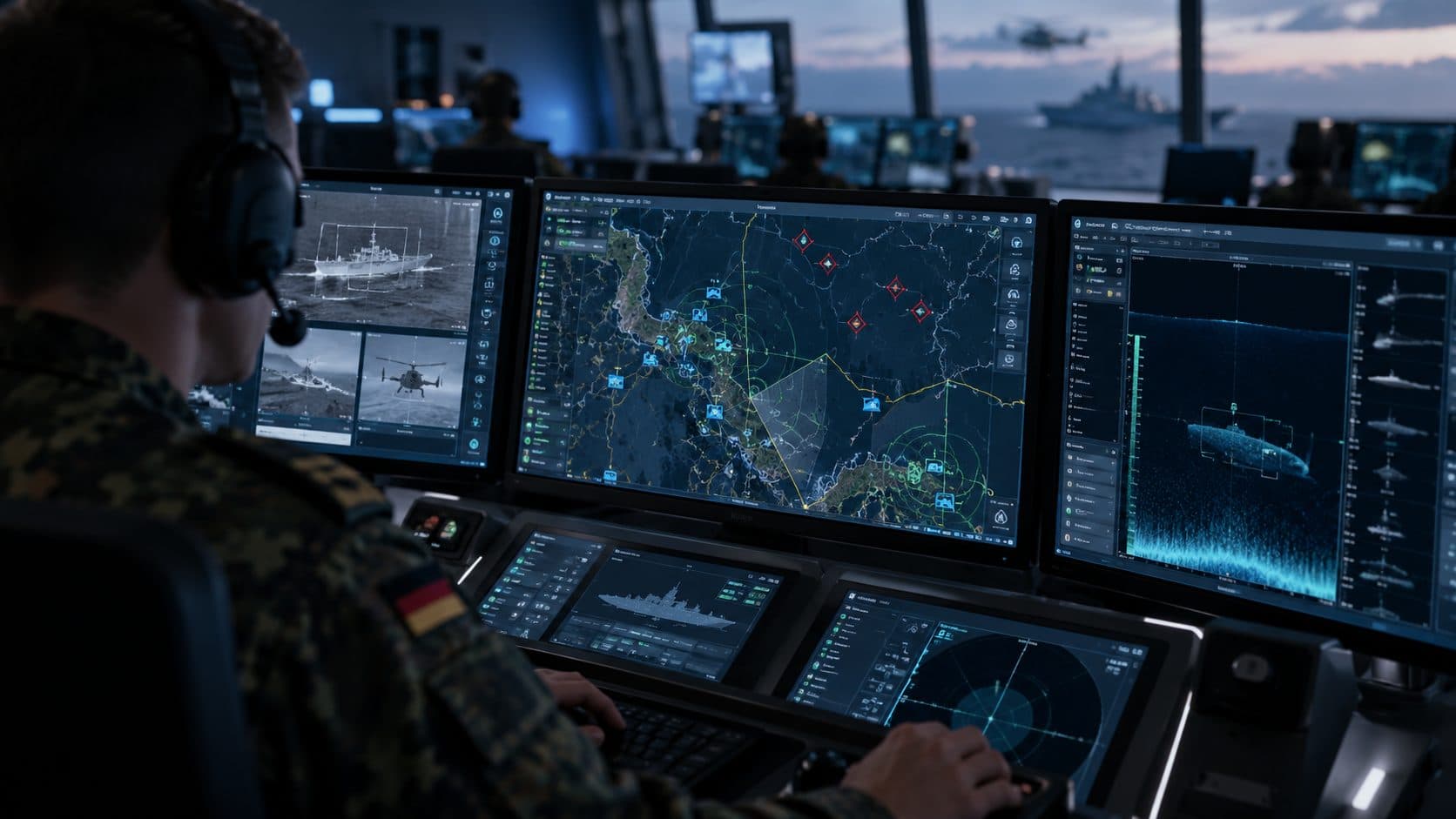
Nexus · Situational awareness
Sensors, effectors and industry in the Bundeswehr's picture.
Nexus connects industry systems to MESE/UNIITY, the open command-system architecture owned by the Bundeswehr, and turns many sources into one situational picture that operators use. Design authority and core stay with the state.
Our role
Where MKS works in the MESE/UNIITY ecosystem.
MESE is the Bundeswehr's software toolkit for command and situational awareness systems: developed since 2012 in Wilhelmshaven, by soldiers for soldiers, regularly tested on NATO exercises since 2017. The Bundeswehr holds design authority and the unified data model. Research, military units and industry deliver via the MESE API into a pool of compatible modules, from which systems for land, sea, air and space are built. Nexus starts at three points in this chain.
AImplement
With military units and customers: set up MESE instances, harden them, make them operable and enable the staff.
BConnect
On the industry side: bring sensors, effectors and C2 systems onto the data bus via SEDAP-Express connectors, with control and feedback.
CBuild modules
In the pool: compatible modules for analysis, data fusion and situational awareness that benefit every user of the ecosystem.
Design authority and data model stay with the Bundeswehr. Nexus does not rebuild the core. Nexus makes it usable.
Data fusion
From many sources to one picture.
One shared picture from separate sources. Five layers, built so that each remains verifiable and can be operated in Bundeswehr hands.
Picture and applications
One picture for operators and command: land, sea, air, space. On MEDAS interfaces, without overlapping windows, on any monitor.
Analysis and assistance
Many reports, few decisions: patterns and deviations are highlighted, priorities proposed, and every proposal explained.
Fusion
Correlation of contacts across sources and time, tracks, identity, quality per source. Traceable which sensor contributed what.
Sources and connectors
Sensors, effectors, link networks and industry systems onto the data bus via SEDAP-Express. Control and feedback included.
Infrastructure
Disconnected network, edge at the node, pCloudBw. Runs on commercial hardware, as a container or as a live system.
The system detects, condenses and proposes. The human decides.
Ecosystem
MESE, UNIITY, SEDAP-Express.
MESE stands for Military Expandable Software Environment: two frameworks, MEDAS for the interface and SEDAP for the middleware. UNIITY is the name of the standard command system that emerges from it across all domains. SEDAP-Express is the lightweight, open-source protocol that brings sensors, effectors and applications into the ecosystem quickly. Nexus builds on it.
UNIITY
Unified Networked Integration of Innovative Technology for C5AIISR. The standard command system from the MESE toolkit.

SEDAP-Express
Lightweight integration protocol for sensors, effectors and applications. Open source under the BSD licence.
For industry
Effectors that appear in the national picture.
Sensors and effectors must connect to national command without a proprietary intermediate command system as a permanent state. Nexus assesses maturity, builds the connection via SEDAP-Express and leads the transition to direct integration into MESE/UNIITY.
An effector that can be controlled, reports back and remains procurable.
Nexus
Sensors, effectors and industry in the Bundeswehr's picture.
Nexus connects industry systems to MESE/UNIITY, the open command-system architecture owned by the Bundeswehr, and turns many sources into one situational picture that operators use. Design authority and core stay with the state.